Nano-devitrification and structural evolution of the amorphous state in surface Ti-Ta-based alloy fabricated on a TiNi substrate through additive thin-film electron-beam synthesis. Henniker’s HPT-100 was used in this work for the removal of carbon contamination before SEM EDS characterisation of the sample surface.
Recently published research from scientists at the Institute of Strength Physics and Materials Science of Siberian Branch Russian Academy of Sciences advances the understanding of Thin Film Metal Glasses (TFMGs) functional properties. TFMGs have the potential to be of great use in the microelectromechanical systems (MEMS) industry due to their small size and other useful properties. In the paper, the thermal stability and crystallisation behaviours of TFMGs with Ti-Ta film and TiNi substrate was examined. Henniker’s HPT-100 was used in this work to remove carbon contamination on the sample’s surface before it was characterised by SEM and EDS measurements.
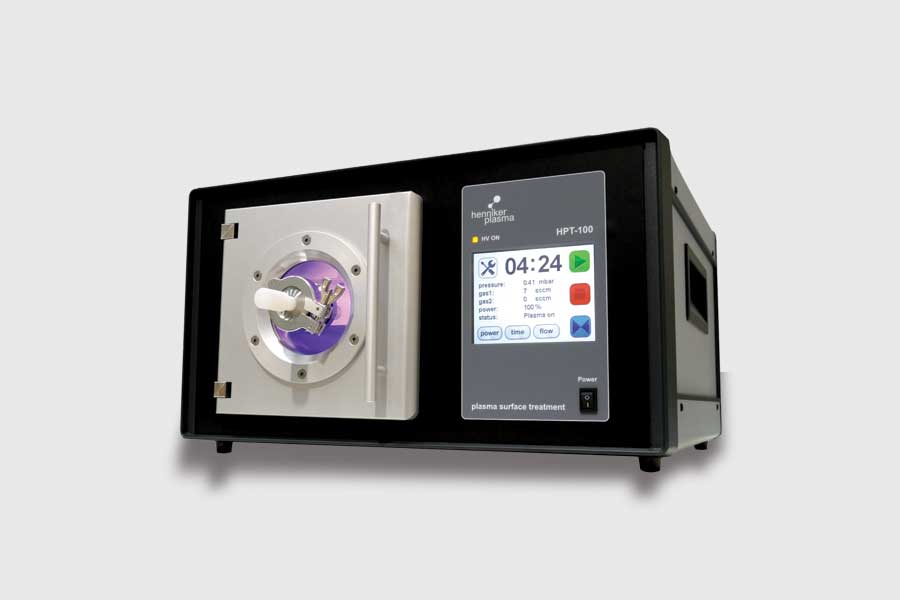
Henniker's HPT-100 TEM Plasma Cleaner
To read the full paper click hereOr view our dedicated Microscopy pages and our TEM plasma cleaner page for more details.
Industry Application
Removing carbon contamination prior to SEM EDS is critical in materials science, electronics failure analysis, and nanotechnology research, where surface cleanliness directly affects elemental mapping accuracy and data reliability.
Keywords:
- Removal of carbon contamination
- SEM
- EDS
- Plasma treatment
- Cleaning microscopy
REQUEST A QUOTATION OR FURTHER INFORMATION
FAQs
Q: Why is carbon contamination a problem before SEM EDS?
A: Carbon layers scatter electrons and obscure elemental mapping, reducing the accuracy of SEM EDS spectroscopy results.
Q: How is carbon contamination removed from SEM samples?
A: Plasma cleaning uses ionised gas to remove surface hydrocarbons without damaging sensitive samples before SEM EDS analysis.
Q: How does cleaner surface preparation improve SEM EDS outcomes?
A: It reduces background noise, improves signal clarity, and enhances elemental resolution for more precise diagnostic or research results.